
Bronze Age seafarers
Minoan Crete and the maritime networks of the Bronze Age
Crete’s location made the sea central to Minoan trade, political communication and cultural exchange with the Cyclades, mainland Greece, Egypt and the eastern Mediterranean.
Crete sat across major eastern Mediterranean routes
The island lies between the Aegean and routes toward Egypt and the Levant, making maritime access economically valuable. Major settlements depended on materials and contacts that arrived from overseas.
The geography encouraged coastal communities and harbours to serve as gateways between palace centres and distant markets.
Imported materials reveal sustained exchange
Copper, tin, ivory, precious stones and other materials reached Crete through long-distance networks, while Minoan pottery and artistic styles circulated abroad.
These flows were too regular to be explained as occasional diplomatic gifts.
Ports connected palace economies with ships
Coastal sites transferred cargo, people and information inland. The exact administrative relationship between palaces and ports varied, but maritime exchange clearly supported elite production and broader consumption.
Harbour archaeology therefore matters as much as palace architecture for understanding Minoan power.
Ship images preserve otherwise lost technology
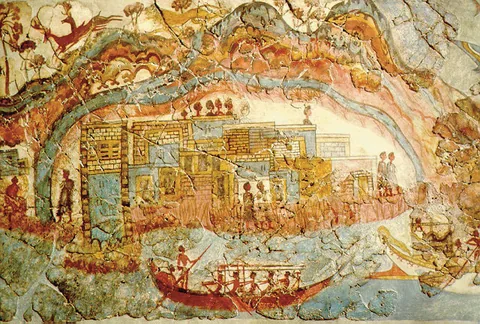
The Akrotiri flotilla fresco and other depictions show long vessels, rowers, steering arrangements and sails. Such images are crucial because complete Bronze Age Aegean hulls rarely survive.
They are artistic sources rather than engineering drawings, so exact dimensions and performance remain reconstruction.
The idea of a Minoan sea empire needs caution
Older scholarship often imagined a centralized Minoan thalassocracy dominating the Aegean. Trade influence and shared material culture, however, do not automatically prove direct political control.
Modern interpretations separate maritime reach from claims of uniform empire.
Thera changed a connected maritime world
The eruption of Thera preserved Akrotiri while disrupting communities across the southern Aegean. Its relationship to later Minoan decline remains debated rather than settled as a single-cause catastrophe.
Maritime activity continued after the eruption, showing resilience as well as disruption.
Minoan history belongs inside a regional system
Crete interacted continuously with Mycenaean Greece, Cyprus, Egypt and the Levant. Studying those links reveals a Bronze Age world already dependent on international maritime exchange.
The Minoan case also shows why archaeology, art and imported goods must be interpreted together.
Akrotiri offers a rare maritime visual archive
The preserved settlement on Thera includes wall paintings that show vessels, coastal settlements and people participating in maritime scenes. Their context helps historians connect ship imagery with everyday Bronze Age society rather than treating ships as isolated technical objects.
What visitors should take from Minoan seafaring
The most defensible conclusion is not that Crete ruled every neighbouring sea. It is that Minoan communities were deeply embedded in overseas exchange and developed political and economic systems that assumed frequent maritime contact.
Evidence, chronology and the limits of reconstruction
The maritime history of Minoan Seafaring and Maritime Networks has to be reconstructed from evidence that survives unevenly. Ports, imported ceramics, anchors, inscriptions, coins, ship remains and foreign accounts can each establish part of the picture, but none can carry the whole argument alone.
An imported object proves movement or exchange. It does not by itself identify the crew, establish one direct voyage or prove political control. Chronology matters because ports shifted, dynasties changed and vessel traditions evolved.
What sustained regular participation in sea travel
Regular seafaring required an economy behind the waterfront. Crews needed water, food, repair materials, pilots and seasonal knowledge, while shipwrights needed timber, fibres, tools and skilled labour.
Merchants depended on storage, credit, brokers and trusted partners across languages and political borders. Maritime strength is therefore better understood through working systems than unsupported fleet claims.
How this tradition fits the wider history of sea travel
Minoan Seafaring and Maritime Networks belonged to connected seas rather than an isolated national story. Cargo often changed hands several times, and sailors borrowed useful practices from neighbouring communities while retaining local traditions.
Political influence could cross water without becoming territorial rule. Comparing maritime systems makes local solutions clearer because every seafaring society faced recurring problems of weather, navigation, provisioning, harbour access and risk.