
Southeast Asian vessels
The Borobudur ship reliefs and early Javanese seafaring
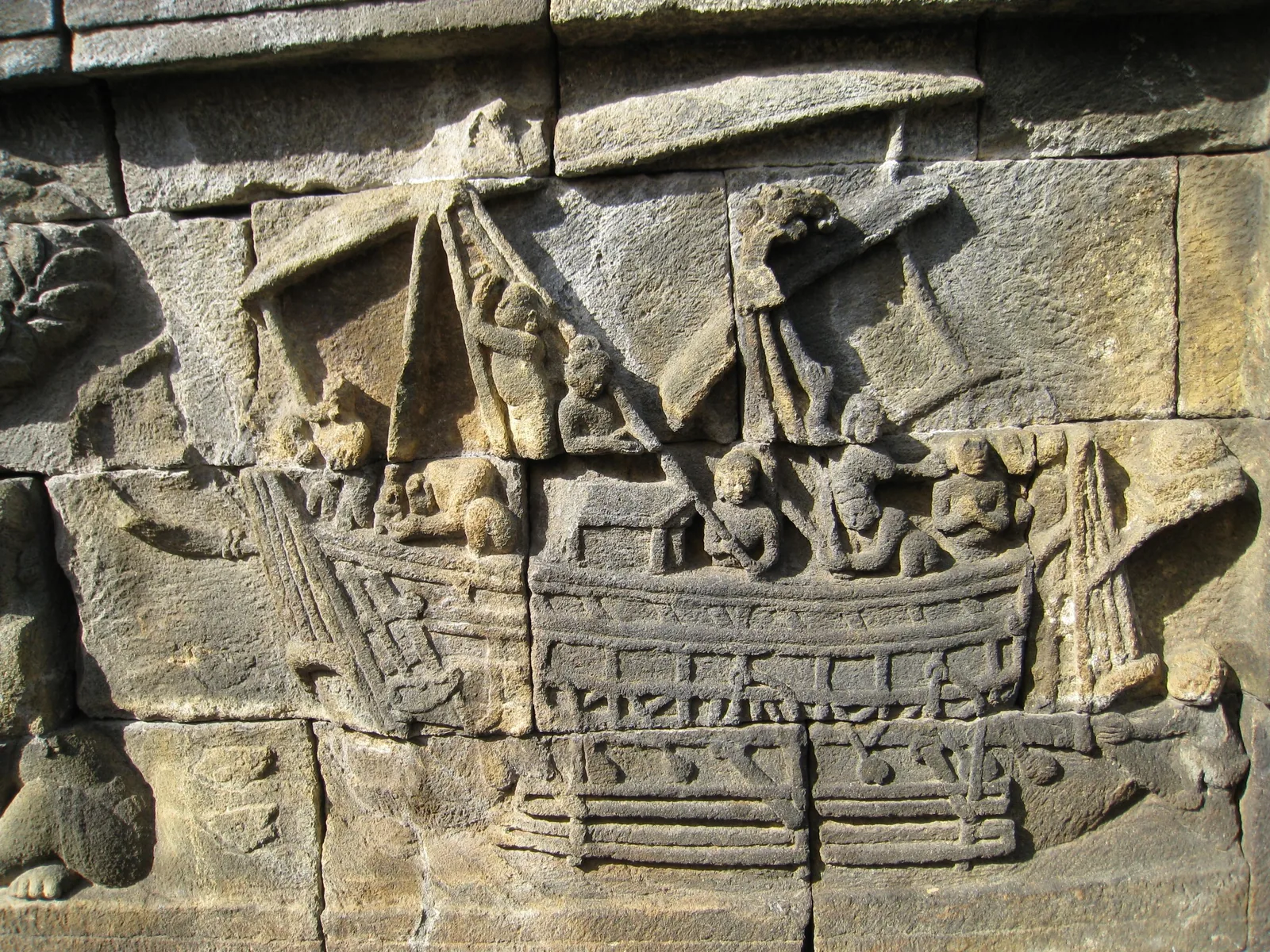
The ship reliefs carved at Borobudur in central Java are among the most valuable visual sources for early medieval Southeast Asian maritime technology. They do not provide engineering plans, but they preserve details of hulls, outriggers, masts, sails and crews from a period when the region was deeply involved in inter-island and long-distance commerce.
Why the Borobudur reliefs matter
Wooden ships rarely survive for centuries in tropical environments, so visual depictions become unusually important. The Borobudur panels show substantial sailing craft with features that can be compared with Austronesian shipbuilding traditions documented elsewhere in the region.
The reliefs are part of a Buddhist monument rather than a technical manual. Their artists selected and stylized details for narrative purposes, so every line cannot be treated as literal engineering evidence.
Outriggers reveal a regional stability solution
Several depicted vessels use outriggers, a characteristic Austronesian solution that adds lateral stability without requiring a very broad main hull. This allowed narrow, efficient hull forms to operate safely in open water.
Outrigger technology connects the reliefs with a much deeper maritime history stretching across island Southeast Asia and into the Pacific.
Sails show adaptation to monsoon seas
The ships carry substantial sails that would have allowed crews to exploit regional wind systems. Rigging details vary between panels, suggesting that artists were familiar with more than one vessel form.
The exact aerodynamic performance cannot be calculated from reliefs alone, but the vessels clearly belong to a sailing tradition suited to regular maritime movement rather than occasional coastal paddling.
Large crews imply organized maritime labour
The carvings depict multiple people engaged with the vessel, indicating that substantial craft required coordinated labour for steering, sail handling and voyage management.
That labour existed within port societies capable of building, provisioning and repairing ships, which links vessel technology directly to the political and economic systems of Java.
Modern reconstructions test possible interpretations
Experimental replicas inspired by Borobudur imagery have completed long voyages, demonstrating that plausible reconstructions of the depicted vessel type can operate effectively at sea.
These experiments are valuable because they test physical feasibility, but they remain modern interpretations filling gaps that the stone relief cannot answer.
The ships fit wider evidence for Southeast Asian trade
Archaeology and written sources show active maritime connections among Java, Sumatra, the Malay world, India and China during the early medieval period. The reliefs therefore sit inside a well-established commercial context.
They are especially useful for correcting older narratives that treated Southeast Asian sailors mainly as passengers within Indian or Chinese maritime systems.
What the reliefs can and cannot prove
They demonstrate sophisticated regional vessel traditions and preserve important visual evidence for outriggers and sail arrangements. They do not tell us exact ship dimensions, cargo capacities or a single standardized “Borobudur ship” design.
The best historical use is therefore comparative: combine the reliefs with archaeology, later shipbuilding traditions and regional trade evidence while keeping reconstruction assumptions visible.
Design choices involved practical trade-offs
The important question about Borobudur Ship Reliefs is not whether it was simply fast, large or technologically advanced. Every vessel balanced cargo capacity, crew size, draft, stability, manoeuvrability, materials and operating waters.
A shallow hull could gain beach or river access while sacrificing volume. A broad merchant hull could move freight economically while responding more slowly. Rig and propulsion reflected winds, voyage length and available labour.
Operating the ship required an entire support system
Sail handling, steering, rowing where relevant, anchoring, pumping, cargo management and emergency repairs demanded practised labour. Longer voyages added water, food, spare cordage, timber and tools that competed with cargo for space.
Ports supplied shipwrights, warehouses, labour, freshwater and safe anchorages. Ship design therefore cannot be separated from the economy that kept the vessel useful after launch day.
What surviving evidence can and cannot establish
Reconstructions of Borobudur Ship Reliefs draw on wreck archaeology, artistic depictions, written descriptions, experimental replicas and later craft traditions. Each source has limits.
A wreck represents one vessel, an image may be stylised and a modern replica necessarily fills gaps. Where evidence disagrees, ranges and alternatives are better than invented precision.