
Nineteenth-century vessels
Clipper ships and the commercial race for speed
Clipper ships represented a nineteenth-century effort to turn sailing speed into commercial advantage. Their fine hulls and large sail plans could produce remarkable passages, but their economics worked only on routes and cargoes where faster delivery justified reduced cargo capacity and demanding crews.
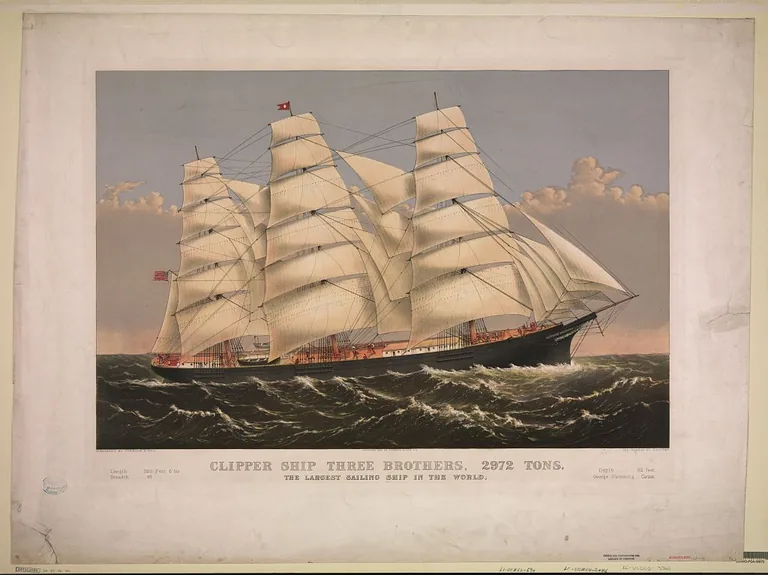
Speed shaped hull proportions
Clippers generally used long, relatively fine hulls designed to reduce resistance and sustain high speed under favourable conditions. This form sacrificed some cargo volume compared with fuller merchant ships.
Builders produced many variations, so the category describes a performance philosophy more than a single blueprint.
Large sail plans demanded skilled crews
Carrying extensive canvas could extract more power from the wind but increased the work required to reef, trim and change sails. Fast sailing depended on crews able to handle the rig safely in difficult conditions.
Headline passage records therefore reflect both vessel design and human performance.
Tea and other time-sensitive cargoes rewarded speed
British tea trade from China became closely associated with clipper competition because the first arrivals could receive commercial attention and sometimes better prices.
Other clippers served California and Australian routes where rapid passenger or cargo movement also mattered.
Weather routing could matter more than direct distance
A fast sailing ship still depended completely on wind. Captains selected routes that sought favourable wind systems even when those routes were geographically longer.
The resulting passage times varied widely, which is why famous records should not be treated as normal scheduled performance.
Competition produced a powerful maritime culture
Owners, captains and newspapers celebrated fast passages, creating reputations around individual ships. Vessels such as Cutty Sark became icons even after the commercial era that produced them changed.
This cultural memory can overshadow the less glamorous freight ships that carried larger volumes of ordinary goods.
The Suez Canal changed route economics
The canal shortened voyages between Europe and Asia, but sailing ships faced challenges using a narrow route where wind propulsion was less convenient. Steamships gained a major advantage because they could maintain powered movement through the canal and Red Sea.
The infrastructure therefore altered which propulsion technology was economically superior.
Steam ended the clipper advantage on many routes
Improving marine engines, fuel efficiency and coaling networks gave steamships increasingly reliable schedules. Commercial shippers often value predictable arrival as much as peak speed.
Clippers remained technically impressive, but the broader transport system shifted toward powered vessels.
Design choices involved practical trade-offs
The important question about Clipper Ships is not whether it was simply fast, large or technologically advanced. Every vessel balanced cargo capacity, crew size, draft, stability, manoeuvrability, materials and operating waters.
A shallow hull could gain beach or river access while sacrificing volume. A broad merchant hull could move freight economically while responding more slowly. Rig and propulsion reflected winds, voyage length and available labour.
Operating the ship required an entire support system
Sail handling, steering, rowing where relevant, anchoring, pumping, cargo management and emergency repairs demanded practised labour. Longer voyages added water, food, spare cordage, timber and tools that competed with cargo for space.
Ports supplied shipwrights, warehouses, labour, freshwater and safe anchorages. Ship design therefore cannot be separated from the economy that kept the vessel useful after launch day.
What surviving evidence can and cannot establish
Reconstructions of Clipper Ships draw on wreck archaeology, artistic depictions, written descriptions, experimental replicas and later craft traditions. Each source has limits.
A wreck represents one vessel, an image may be stylised and a modern replica necessarily fills gaps. Where evidence disagrees, ranges and alternatives are better than invented precision.