
Interactive learning
Polynesian wayfinding explorer
Work through a simplified open-ocean wayfinding scenario and see how several environmental clues can support one another. The exercise teaches the logic of combined observation rather than claiming to reproduce a complete traditional navigation system.
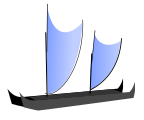
Select the observations to see how a navigator might weigh them together.
Why several clues are more useful than one
Traditional Pacific wayfinding is often simplified into a story about following stars. Stars matter, but a navigator can also read swells, winds, cloud behaviour and birds. Each clue has limits. Stars disappear behind clouds, local wind waves can hide a longer swell, and seabirds do not always point directly toward land.
The practical strength comes from comparison. A star bearing can establish a direction at night. A persistent swell can help maintain orientation when the sky is obscured. Bird behaviour can become more useful during landfinding, especially when interpreted with knowledge of local species and time of day.
The explorer does not reproduce a complete star compass
Real wayfinding requires detailed cultural knowledge, memorised star paths, sustained observation and experience reading the ocean. This tool isolates a few principles for education. It should not be treated as training for navigation at sea or as a complete model of Polynesian practice.