
Historical vessels
Greek trireme: crew, construction and naval warfare
The trireme was a specialized Mediterranean warship built around human power, speed and tactical manoeuvre. Understanding it requires more than knowing that it had three banks of oars: its hull, crew, finances, training and naval bases formed one integrated military system.
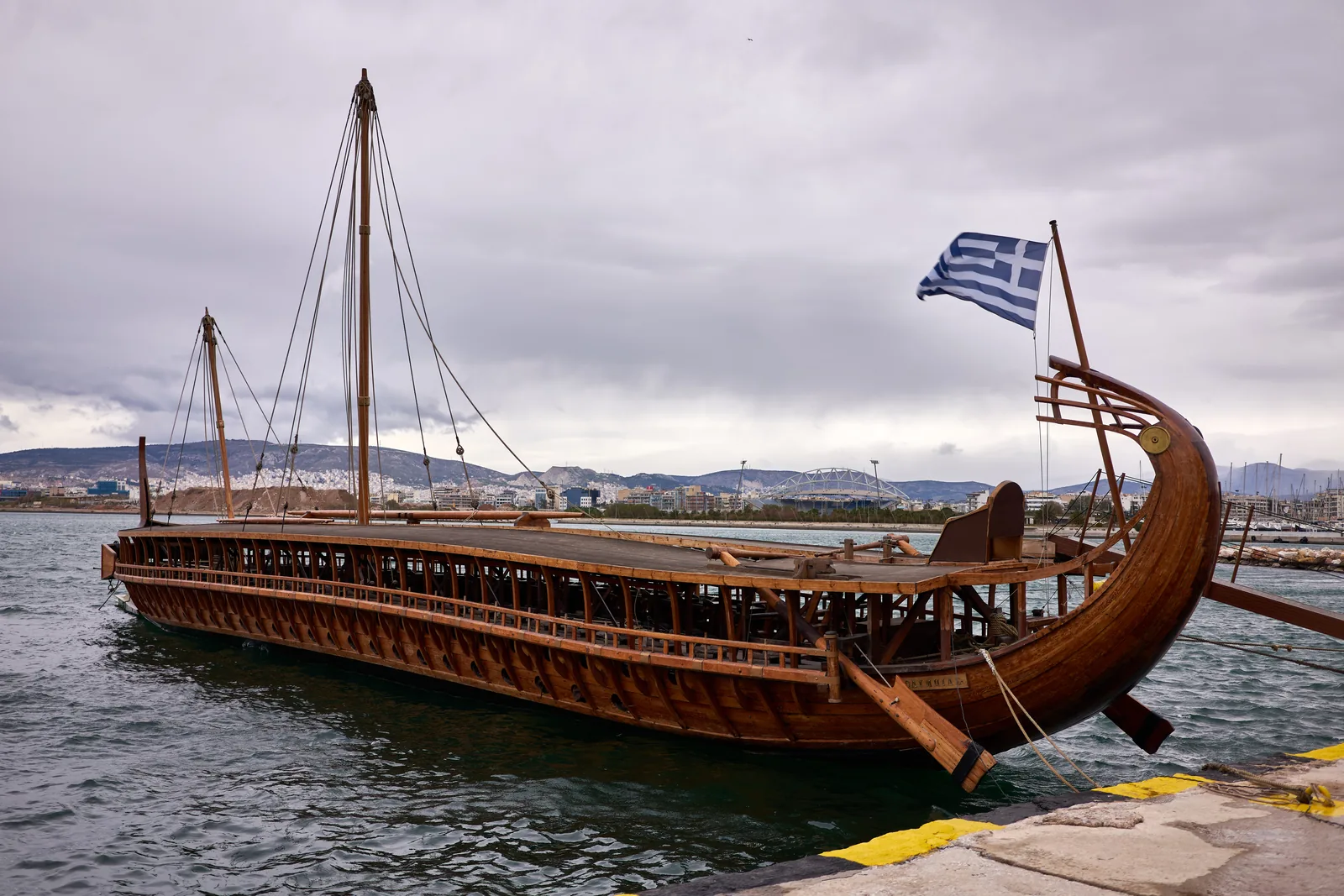
Three banks of oars created a demanding human engine
The trireme’s defining arrangement placed rowers at three vertical levels, allowing a long, relatively narrow hull to concentrate a very large rowing crew. Classical Athenian triremes are generally reconstructed with around 170 rowers, although exact details can vary by period and fleet. This workforce was not simply ballast with paddles. Coordinated rowing required training, discipline and commands that could turn hundreds of individual strokes into controlled acceleration and manoeuvre.
The manpower requirement helps explain the political economy of naval states such as Athens. Building a hull was only the beginning. A city needed thousands of trained rowers, wages or civic obligations, food, harbour facilities and continuous maintenance. Naval power therefore rested on social organization as much as ship design.
The hull sacrificed cargo capacity for performance
Triremes were long and comparatively narrow, with shallow draft useful for coastal operations and beaching. Their lightweight construction improved acceleration but made them less suited to carrying heavy commercial cargo or remaining at sea for long unsupported periods.
This distinction matters because ancient naval warfare and merchant shipping served different logistical worlds. A broad merchant vessel could move grain economically with a small crew. A trireme carried an enormous crew in order to create speed and combat manoeuvrability.
The bronze ram turned the ship itself into a weapon
The bow ram projected near the waterline and was designed to damage an enemy hull. Ramming tactics required the attacking crew to approach at speed, strike effectively and then avoid becoming trapped or exposed to counterattack.
Naval combat also involved boarding, missile fire and formation tactics. The trireme should therefore not be imagined as a simple underwater battering ram. Success depended on command, crew coordination and the wider tactical situation.
Sails were useful for travel but oars dominated combat
Triremes carried sails for passages when wind conditions were favourable, reducing the physical burden of continuous rowing. In combat, however, sail handling could interfere with manoeuvre and the oars gave commanders direct control over speed and direction.
The contrast illustrates a recurring principle in ship history: propulsion systems are judged by the problem being solved. Sail was efficient for passage, while rowing provided tactical responsiveness in close naval operations.
Athenian naval power depended on Piraeus and public finance
Athens developed Piraeus into a major naval and commercial harbour complex. Ship sheds protected triremes when out of water, while dockyards and craftsmen maintained hulls, rigging and equipment. The fleet also depended on timber supply and financial systems supporting construction and crew service.
The trireme therefore belonged to an urban infrastructure. A modern visitor who sees only a reconstruction at sea misses the warehouses, harbour walls, taxation, political decisions and labour organization that made fleets possible.
The modern Olympias reconstruction tested practical questions
Olympias, a twentieth-century full-scale reconstruction, was built to test scholarly ideas about ancient trireme design and rowing. Sea trials demonstrated that a large three-level rowing system could work and provided useful evidence about speed, turning and crew ergonomics.
A reconstruction is still an experiment rather than an original archaeological vessel. Its value lies in testing whether proposed arrangements are physically plausible, not proving that every ancient trireme matched the reconstruction exactly.
What archaeology and texts can actually tell us
Ancient literary accounts describe fleets and battles, iconography preserves ship forms, and harbour archaeology reveals naval infrastructure. Individual wooden hulls survive poorly, so historians must combine evidence rather than rely on one perfect shipwreck.
That evidence supports a detailed functional picture while leaving room for regional and chronological variation. Precise speed claims should be treated as performance ranges under specific conditions rather than universal specifications.
Design choices involved practical trade-offs
The important question about Greek Trireme is not whether it was simply fast, large or technologically advanced. Every vessel balanced cargo capacity, crew size, draft, stability, manoeuvrability, materials and operating waters.
A shallow hull could gain beach or river access while sacrificing volume. A broad merchant hull could move freight economically while responding more slowly. Rig and propulsion reflected winds, voyage length and available labour.
Operating the ship required an entire support system
Sail handling, steering, rowing where relevant, anchoring, pumping, cargo management and emergency repairs demanded practised labour. Longer voyages added water, food, spare cordage, timber and tools that competed with cargo for space.
Ports supplied shipwrights, warehouses, labour, freshwater and safe anchorages. Ship design therefore cannot be separated from the economy that kept the vessel useful after launch day.
What surviving evidence can and cannot establish
Reconstructions of Greek Trireme draw on wreck archaeology, artistic depictions, written descriptions, experimental replicas and later craft traditions. Each source has limits.
A wreck represents one vessel, an image may be stylised and a modern replica necessarily fills gaps. Where evidence disagrees, ranges and alternatives are better than invented precision.