
Historical vessels
Roman merchant ships and Mediterranean cargo transport
Roman cities depended on ordinary merchant shipping far more than on spectacular naval battles. Broad sailing vessels moved grain, wine, olive oil, stone, fish products and manufactured goods across a Mediterranean economy in which sea transport made bulk movement practical.
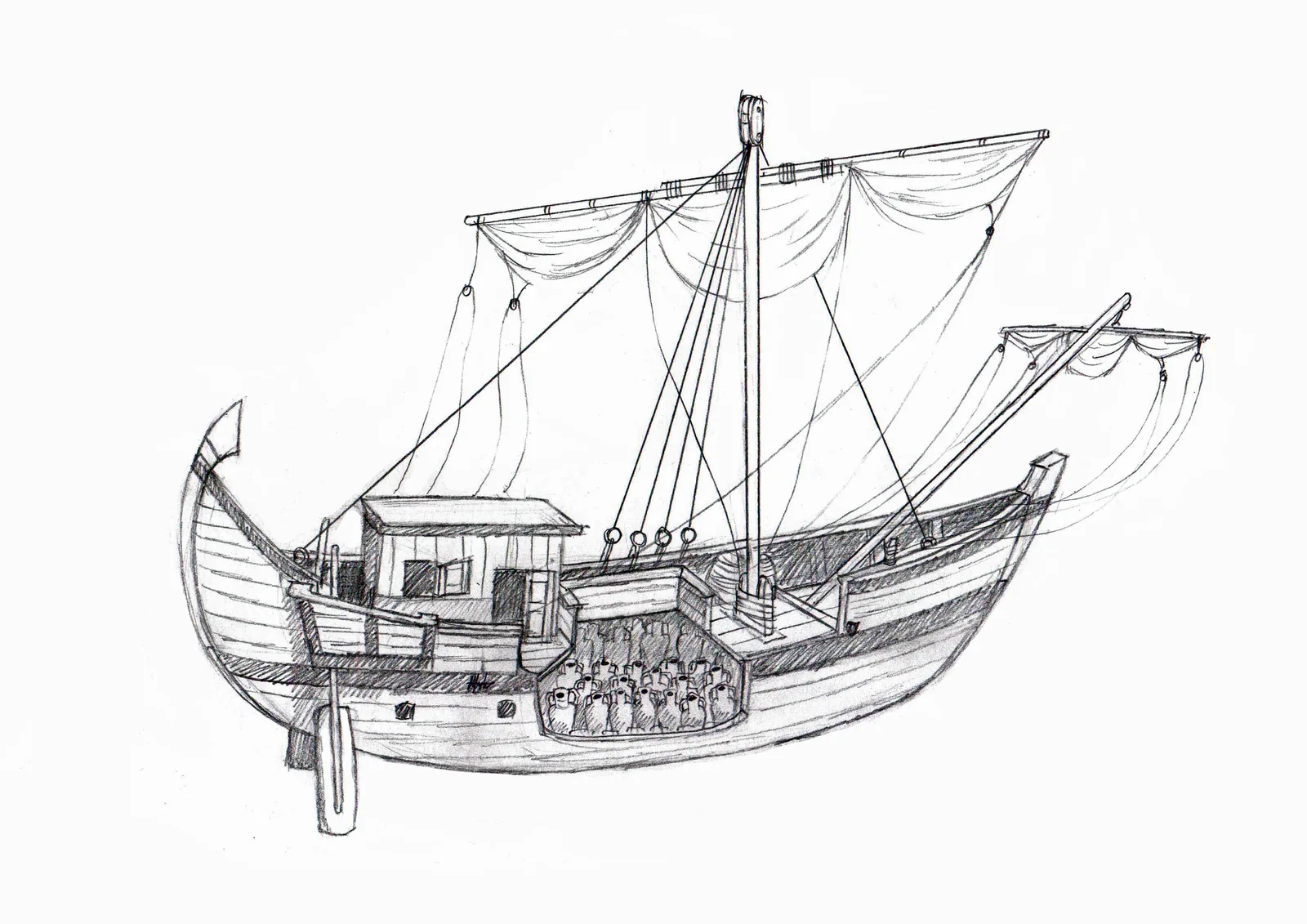
There was no single Roman merchant-ship design
Roman commercial vessels varied widely in size, construction and route. Some served short coastal traffic, while larger ships carried substantial cargo across the Mediterranean. Archaeological wrecks show differences in hull form and load, so the term “Roman merchant ship” should be understood as a broad functional category.
Many vessels used mortise-and-tenon joinery and shell-first construction traditions characteristic of the ancient Mediterranean, though methods changed over time. A broad hull maximized useful cargo space rather than the tactical speed expected of an oared warship.
Sails made economical freight movement possible
Square sails were common on large merchant vessels, allowing relatively small crews to move cargo that would require enormous labour overland. The trade-off was dependence on wind direction and weather.
Ancient sailing therefore combined low transport cost with timetable uncertainty. A profitable merchant had to think in seasonal windows rather than modern delivery dates.
Grain ships sustained Rome
Rome’s population required huge food imports. Egypt and North Africa became major grain-producing regions, and maritime transport carried bulk grain toward Italian ports. This supply system depended on warehouses, state administration, private shipping and harbour infrastructure.
Grain illustrates why cargo value alone does not define maritime importance. Pepper might be more valuable per kilogram, but bulk food shipping could determine whether a city of hundreds of thousands was fed.
Amphorae preserve the geography of trade
Wine, olive oil, fish sauces and other commodities often travelled in amphorae. Different regions produced characteristic vessel forms, stamps and clay fabrics, allowing archaeologists to trace distribution patterns.
A wreck filled with amphorae is therefore both a cargo disaster and a historical dataset. It can reveal origin regions, packing methods and the commercial relationships connecting ports.
Ports handled transfer, storage and taxation
Alexandria, Ostia, Puteoli and many smaller harbours linked shipping with urban markets. Cargo might move from a seagoing vessel to smaller craft capable of navigating rivers or shallow harbour approaches.
The commercial voyage did not end when the ship reached the coast. Warehousing, customs, labour gangs and inland transport completed the journey.
Passengers often travelled aboard working cargo ships
Ancient passenger travel did not normally operate as a separate cruise or liner industry. Merchants, officials, soldiers and other travellers could obtain passage on ships whose main business was cargo.
Comfort and departure certainty varied. A traveller might wait for a ship, accept crowded conditions and depend on the captain’s commercial itinerary rather than choose a fixed passenger timetable.
Wrecks reveal both normal practice and exceptional events
Roman-period wrecks preserve hulls, anchors, personal objects and cargo assemblages. They provide direct evidence unavailable from literary texts, which often focus on elite concerns or dramatic disasters.
Yet wrecks are a biased sample because ships that arrived safely leave less concentrated archaeological evidence. Historians therefore compare many sites before generalizing about typical vessel size or cargo.
Design choices involved practical trade-offs
The important question about Roman Merchant Ships is not whether it was simply fast, large or technologically advanced. Every vessel balanced cargo capacity, crew size, draft, stability, manoeuvrability, materials and operating waters.
A shallow hull could gain beach or river access while sacrificing volume. A broad merchant hull could move freight economically while responding more slowly. Rig and propulsion reflected winds, voyage length and available labour.
Operating the ship required an entire support system
Sail handling, steering, rowing where relevant, anchoring, pumping, cargo management and emergency repairs demanded practised labour. Longer voyages added water, food, spare cordage, timber and tools that competed with cargo for space.
Ports supplied shipwrights, warehouses, labour, freshwater and safe anchorages. Ship design therefore cannot be separated from the economy that kept the vessel useful after launch day.
What surviving evidence can and cannot establish
Reconstructions of Roman Merchant Ships draw on wreck archaeology, artistic depictions, written descriptions, experimental replicas and later craft traditions. Each source has limits.
A wreck represents one vessel, an image may be stylised and a modern replica necessarily fills gaps. Where evidence disagrees, ranges and alternatives are better than invented precision.