
Southeast Asian maritime kingdoms
Srivijaya and the Strait of Malacca maritime world
Srivijaya became one of Southeast Asia’s most influential maritime powers by operating within the trade routes that joined the Indian Ocean and South China Sea. Its strength came from strategic geography, port relationships, religious prestige and the ability to benefit from passing commerce.
Sumatra sat beside one of Asia’s great maritime chokepoints
The Strait of Malacca links the Indian Ocean with the South China Sea through a narrow corridor between Sumatra and the Malay Peninsula. Ships moving between India, Southeast Asia and China often passed through or near this region.
Geography created opportunity but did not guarantee dominance. A maritime state still needed secure ports, political alliances, pilots, supplies and the ability to attract or compel merchant participation.
Srivijaya was a networked polity rather than a modern bounded nation-state
Inscriptions and foreign accounts suggest a political system centred in Sumatra with influence extending through connected ports and river systems. Authority could depend on personal allegiance, tribute and control of strategic nodes rather than fixed borders mapped in the modern sense.
This model fits an archipelagic environment where waterways were often easier routes than roads. Rivers connected interior products with coastal ports, while sea lanes linked those ports to international merchants.
Palembang is central to many reconstructions
The Musi River region around Palembang has long been associated with Srivijaya’s core. River access allowed inland goods to reach maritime routes while offering sheltered areas for settlement and administration.
Archaeological interpretation remains complex because tropical environments, later settlement and river changes obscure the physical remains of early maritime cities. Srivijaya’s importance is therefore reconstructed from multiple kinds of evidence rather than one monumental capital.
Buddhism strengthened Srivijaya’s international connections
Chinese Buddhist travellers describe Srivijaya as an important place for study and preparation before onward travel to India. Religious prestige connected the polity with intellectual networks stretching across maritime Asia.
Buddhist institutions also intersected with diplomacy and commerce. The Nagapattinam monastery linked to a Srivijayan ruler and supported by Chola authority is one example of how religious patronage could express relationships between maritime powers.
Merchants moved through Srivijaya rather than belonging to it
Chinese, Indian, Malay, Arab and other merchants used overlapping Asian sea routes. Srivijaya could profit from this movement through port dues, provisioning and control of strategic passages without owning the merchants or ships involved.
This distinction is important because claims that Srivijaya “controlled all trade” oversimplify a diverse commercial world. Political influence could be strong while merchants still retained choices among ports and routes.
Local vessels belonged to deep Austronesian traditions
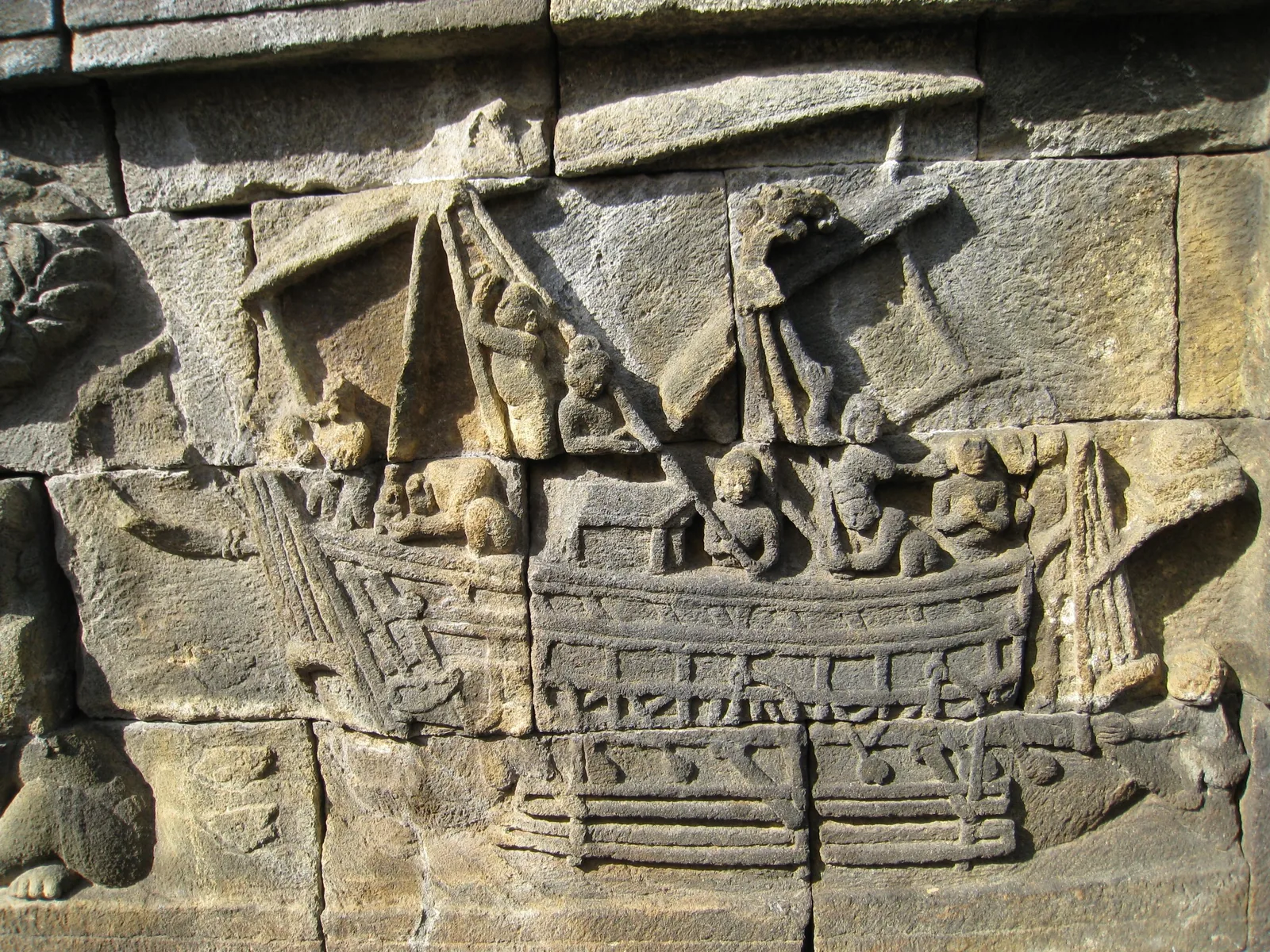
Southeast Asian shipbuilding traditions included outrigger vessels and large plank-built ships capable of substantial cargo carriage. Borobudur reliefs provide valuable visual evidence for complex early medieval sailing craft in Java, although they are not direct pictures of a standardized Srivijayan fleet.
Foreign descriptions of large regional ships reinforce the broader conclusion that Southeast Asian societies possessed sophisticated maritime technology before European arrival.
The Chola attack of 1025 disrupted strategic centres
Rajendra Chola I’s inscriptions list places attacked in a campaign associated with the Srivijayan sphere. The expedition demonstrates the ability of the Chola state to project military force across the Bay of Bengal and strike important commercial nodes.
It did not convert Srivijaya into a permanent Chola province. Srivijayan power continued afterward, though regional political and commercial patterns gradually changed. Describing the event as a raid or intervention is historically safer than imagining a lasting conquest of Southeast Asia.
Srivijaya declined as networks and rivals changed
No maritime state controls strategic geography forever. Competition among regional powers, changing trade routes, political fragmentation and the rise of other ports reduced Srivijaya’s dominance over time.
Later Malacca would become famous for exploiting the same broad chokepoint. The continuity shows how geography can remain valuable even as the political system controlling it changes completely.
Why Srivijaya matters to maritime history
Srivijaya demonstrates a form of power built around movement rather than vast inland territorial control. Ports, river mouths and straits could become the foundation of political authority when long-distance commerce passed through them.
It also helps connect South Indian, Chinese and Southeast Asian history within one maritime system. No one region can be understood properly if the others are treated merely as distant trading partners.
Evidence, chronology and the limits of reconstruction
The maritime history of Srivijaya and the Strait of Malacca has to be reconstructed from evidence that survives unevenly. Ports, imported ceramics, anchors, inscriptions, coins, ship remains and foreign accounts can each establish part of the picture, but none can carry the whole argument alone.
An imported object proves movement or exchange. It does not by itself identify the crew, establish one direct voyage or prove political control. Chronology matters because ports shifted, dynasties changed and vessel traditions evolved.
What sustained regular participation in sea travel
Regular seafaring required an economy behind the waterfront. Crews needed water, food, repair materials, pilots and seasonal knowledge, while shipwrights needed timber, fibres, tools and skilled labour.
Merchants depended on storage, credit, brokers and trusted partners across languages and political borders. Maritime strength is therefore better understood through working systems than unsupported fleet claims.
How this tradition fits the wider history of sea travel
Srivijaya and the Strait of Malacca belonged to connected seas rather than an isolated national story. Cargo often changed hands several times, and sailors borrowed useful practices from neighbouring communities while retaining local traditions.
Political influence could cross water without becoming territorial rule. Comparing maritime systems makes local solutions clearer because every seafaring society faced recurring problems of weather, navigation, provisioning, harbour access and risk.